
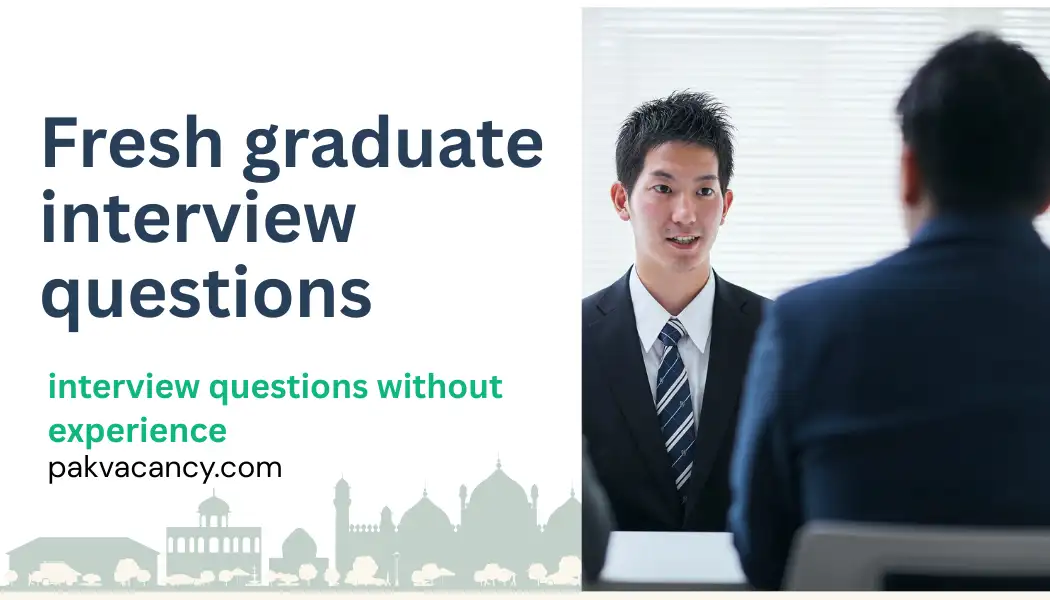
Top 20 Interview Questions for Fresh Graduates in Pakistan
Article Details
Top 20 Interview Questions and Answers for Fresh Graduates in Pakistan
Attending your first professional job interview can be stressful, especially when you do not have extensive work experience. However, employers hiring fresh graduates usually do not expect candidates to have years of professional experience.
Instead, interviewers often evaluate your education, communication skills, confidence, attitude, problem-solving ability, willingness to learn and understanding of the position.
Practical skills are becoming increasingly important for Pakistani graduates. The Higher Education Commission has introduced initiatives connecting undergraduate education with internships, professional certifications and industry-relevant competencies to improve graduate employability.
This guide covers 20 common interview questions and answers for fresh graduates in Pakistan. The sample answers can be adapted for IT, banking, engineering, marketing, finance, education, government and other entry-level positions.
Do not memorize these answers word for word. Use them as a framework and replace the examples with your actual education, projects, internships, skills and career goals.
How Should Fresh Graduates Answer Interview Questions?
Fresh graduates should keep their answers:
- Relevant to the position
- Honest and specific
- Between 30 seconds and two minutes
- Supported by examples
- Focused on skills and learning potential
- Free from unnecessary personal details
For behavioural questions, use the STAR method:
- Situation: Briefly explain what happened.
- Task: Describe your responsibility.
- Action: Explain what you personally did.
- Result: Share the final result or lesson.
Career-services guidance recommends using the STAR structure to provide clear examples when answering questions about challenges, failures, teamwork and decision-making.
1. Tell Me About Yourself
This is often the first question in a job interview. The interviewer does not need your complete life history. They want a brief professional introduction connecting your education and skills with the position.
Sample answer
“I recently completed my BS in Computer Science from [University Name]. During my degree, I developed a strong interest in web development and completed projects using React, Node.js and SQL.
I also completed a three-month internship where I assisted with application testing, bug reporting and frontend development. These experiences improved my technical, teamwork and problem-solving skills.
I am now looking for an entry-level software-development position where I can contribute my skills, learn from experienced professionals and grow as a developer.”
Alternative answer for a business graduate
“I recently completed my BBA with a specialization in marketing from [University Name]. During my studies, I worked on projects related to market research, customer behaviour and digital marketing.
I also managed social-media campaigns for a university society, where I learned content planning, audience engagement and performance reporting. I am now looking for an opportunity where I can apply my marketing knowledge and continue developing practical industry experience.”
Best structure
Use this three-part format:
- Present education and specialization.
- Mention relevant skills, projects or internships.
- Explain why you are interested in the position.
A strong answer should explain your professional direction and why the role fits your next career step.
2. Why Should We Hire You?
The interviewer wants to know what value you can offer despite having limited professional experience.
Avoid saying, “Because I need this job.” Focus on your relevant skills, work ethic and ability to learn.
Sample answer
“You should consider hiring me because I have the foundational skills required for this position and a strong willingness to learn.
During my final-year project, I worked with a team to develop an inventory-management system. I was responsible for database design, interface development and testing. This experience taught me how to manage responsibilities, solve technical problems and meet deadlines.
Although I am a fresh graduate, I am adaptable, responsible and prepared to put in the effort required to become a productive member of your team.”
Key points to include
- Relevant academic knowledge
- Internship or project experience
- Communication and teamwork
- Ability to learn quickly
- Genuine interest in the position
3. Why Do You Want to Work for Our Company?
Employers use this question to determine whether you researched the organization or submitted applications randomly.
Before the interview, study:
- The company’s website
- Products and services
- Industry
- Recent projects
- Mission and values
- Job description
- Company social-media pages
Sample answer
“I want to work for your company because of its strong reputation in software development and its focus on building practical digital solutions.
I reviewed your website and learned that your team works on web applications for healthcare and education clients. These areas interest me because technology can create a meaningful impact in both sectors.
The junior developer position also matches my skills in JavaScript, React and database development. I believe this role would allow me to contribute while learning from an experienced development team.”
Avoid this answer
“I heard that your company pays good salaries.”
Salary is important, but it should not be presented as your only reason for applying.
4. What Are Your Greatest Strengths?
Choose two or three strengths that are relevant to the position. Support at least one strength with a genuine example.
Sample answer
“One of my main strengths is problem-solving. During my final-year project, our application stopped retrieving data correctly shortly before the presentation.
I reviewed the API requests, checked the database queries and identified an incorrect parameter in the backend. After correcting and testing it, the application worked successfully during the presentation.
I would also describe myself as organized and willing to learn. I normally divide large assignments into smaller tasks and set personal deadlines to complete them on time.”
Good strengths for fresh graduates
- Quick learner
- Communication
- Problem-solving
- Organization
- Teamwork
- Attention to detail
- Adaptability
- Time management
- Technical proficiency
- Responsibility
Do not mention strengths that have no connection with the vacancy.
5. What Is Your Greatest Weakness?
The interviewer is checking your self-awareness and willingness to improve.
Do not claim that you have no weaknesses. Select a real but manageable weakness and explain what you are doing to address it.
Sample answer
“I previously found it difficult to speak confidently in front of large groups. I could explain my ideas well in smaller teams, but formal presentations made me nervous.
To improve, I volunteered to present two university projects and began practising my presentations in advance. I also recorded myself to identify problems with my speed and delivery.
I am still improving, but I am now much more comfortable presenting information to a group.”
Other suitable weaknesses
- Delegating tasks
- Public speaking
- Asking for help too late
- Spending too long checking minor details
- Limited experience with a particular tool
- Nervousness during initial client conversations
Never select a weakness that makes you unsuitable for the main responsibility of the job.
6. You Do Not Have Experience. Why Should We Select You?
Fresh graduates frequently face this question. Do not become defensive. Connect your academic and practical experience with the employer’s requirements.
Sample answer
“It is true that I am at the beginning of my professional career, but I have developed relevant experience through university projects, online training and an internship.
For example, during my internship, I assisted the accounts department with invoice records, Excel reports and bank reconciliations. I learned how accuracy, confidentiality and documentation are handled in a professional environment.
I may require initial guidance, but I learn quickly, accept feedback positively and am committed to developing the skills needed for the position.”
Remember
Academic projects, volunteer work, internships, freelance assignments, society leadership and family-business responsibilities can all demonstrate relevant skills.
Do not present them as full-time employment when they were not.
7. Tell Us About Your Final-Year Project
This question is common for IT, engineering, business, science and other graduate positions.
Explain:
- The problem
- Your individual responsibility
- The tools or methods used
- The result
- What you learned
Sample answer
“My final-year project was a web-based appointment-management system for small clinics.
Our objective was to help clinics manage patients, doctors and appointment schedules digitally. I was responsible for developing the user interface and integrating it with the backend APIs.
We used React for the frontend, Node.js for the backend and MongoDB for the database. One challenge was preventing duplicate appointments, so we added schedule validation before confirming a booking.
The project improved my development, debugging and teamwork skills. It also taught me the importance of collecting user requirements before starting development.”
Important tip
Use “I” when describing your personal contribution and “we” when describing the team’s overall work.
8. Tell Me About a Challenge You Faced
The employer wants evidence that you can remain calm, examine a problem and work toward a solution.
Sample answer
“During my final semester, two major project deadlines were scheduled in the same week. I initially felt that managing both would be difficult.
I listed all the remaining tasks, divided them according to urgency and created a daily schedule. I also coordinated with my team members so that responsibilities were clearly assigned.
We completed both projects before their deadlines and received positive feedback. The experience taught me to start planning early and communicate before a workload becomes unmanageable.”
Avoid
Do not blame teachers, classmates, managers or family members. Keep the answer focused on your actions and learning.
9. Describe a Time You Worked in a Team
Teamwork questions are common because most jobs require collaboration with colleagues, managers, clients or other departments.
Sample answer
“In one university course, our team had to prepare a business plan for a new online service. There were five members, but initially, everyone had different ideas about the target market.
I suggested that we compare each idea using the same criteria, including customer demand, cost and feasibility. After discussing the findings, we agreed on one direction and divided the work according to each member’s strengths.
I prepared the financial estimates and helped combine the final presentation. We submitted the project on time and received one of the highest grades in the class.”
What this answer demonstrates
- Listening
- Cooperation
- Decision-making
- Responsibility
- Conflict prevention
- Focus on results
10. How Do You Handle Disagreements With Team Members?
Do not say that you never experience disagreements. Healthy professional disagreement is normal.
Sample answer
“I try to understand the other person’s reasoning before defending my own position. I focus on the task rather than making the disagreement personal.
During a group project, one team member wanted to add several features shortly before the submission deadline. I was concerned that this could make the project unstable.
I suggested separating the essential features from optional improvements. We completed and tested the essential features first, then added one optional feature because enough time remained.
This allowed us to protect the quality of the project while still considering the team member’s idea.”
11. Tell Me About a Mistake or Failure
The interviewer is not searching for a perfect candidate. They want to see whether you accept responsibility and learn from mistakes.
Sample answer
“During an internship, I prepared an Excel report using data from an outdated file. My supervisor noticed the difference before the report was shared externally.
I accepted the mistake, updated the report using the correct data and checked all formulas again. After that experience, I started confirming file dates and source versions before preparing reports.
The mistake taught me that accuracy includes checking the source of the information, not only reviewing calculations.”
Good answer structure
- Admit the mistake.
- Explain how you corrected it.
- Share what you learned.
- Describe how you prevent it now.
Avoid describing a serious ethical violation or blaming someone else.
12. Describe a Time You Demonstrated Leadership
Leadership does not always mean managing employees. Fresh graduates can demonstrate leadership through university projects, volunteer activities, sports teams and student societies.
Sample answer
“During our final-year project, our team began falling behind because responsibilities were not clearly assigned.
I arranged a meeting where we divided the project into smaller tasks, assigned owners and created weekly deadlines. I also maintained a shared progress document and followed up when someone needed support.
As a result, we completed the core features before the final testing week. This experience taught me that leadership is not only giving instructions; it also involves communication, planning and helping the team succeed.”
13. How Do You Work Under Pressure?
Employers want to know whether you can prioritize tasks without compromising quality.
Sample answer
“I manage pressure by identifying the most urgent tasks and focusing on one clear priority at a time.
During my final examinations, I was also completing an internship assignment. I created a schedule covering study time, assignment tasks and review deadlines. I informed my internship supervisor early about my examination dates and completed the major assignment work before the busiest week.
The experience taught me that pressure becomes more manageable when expectations are clear and work is planned early.”
Avoid saying
“I work best only under pressure.”
This may suggest that you delay work until the deadline approaches.
14. Where Do You See Yourself in Five Years?
The interviewer wants to assess whether your goals are realistic and connected to the available position.
Sample answer
“In five years, I hope to have developed strong professional expertise in financial analysis and reporting.
Initially, I want to understand the company’s systems, improve my practical accounting skills and become dependable in my assigned responsibilities. As I gain experience, I would like to handle more complex reporting and contribute to budgeting or financial planning.
I am not focused only on a particular title. My priority is to develop valuable skills, produce reliable work and gradually accept greater responsibility.”
Best approach
Mention:
- Skill development
- Increasing responsibility
- Contribution to the organization
- A realistic career direction
Do not tell the interviewer that you plan to leave the company immediately after gaining experience.
15. What Are Your Salary Expectations?
Fresh graduates often struggle with this question. Research salaries for similar entry-level positions in your city and industry before the interview.
Do not provide an unrealistic figure without understanding the role.
Sample answer when you know the market range
“Based on my research and the responsibilities of this entry-level position, I understand that similar roles generally offer around Rs50,000 to Rs65,000 per month.
However, I am open to discussing the complete package, including training, responsibilities, benefits and growth opportunities.”
Sample answer when no salary information is available
“As a fresh graduate, my priority is finding a suitable position where I can learn and contribute. I would expect a fair salary aligned with the company’s structure and the responsibilities of the role.
Could you please share the approved salary range for this position?”
Important tips
- Give a range rather than one fixed number.
- Consider benefits, bonuses, medical coverage and travel allowance.
- Never say that salary does not matter.
- Do not quote a senior-level salary for an entry-level vacancy.
- Avoid providing false information about previous earnings.
16. Why Did You Choose This Field?
Your answer should show genuine interest and evidence that you understand the career.
Sample answer for an IT graduate
“I chose software development because I enjoy solving problems and building something that people can use.
My interest developed during my second semester when I created a basic student-record application. I enjoyed converting requirements into working features and identifying errors when the application did not behave as expected.
Since then, I have completed additional web-development projects and courses. This confirmed that I want to build my career in software engineering.”
Sample answer for a finance graduate
“I selected finance because I am interested in how businesses make decisions using financial information.
During my degree, subjects such as financial management and investment analysis helped me understand how budgeting, risk and cash flow affect an organization. I would now like to apply this knowledge in a professional environment.”
17. Are You Willing to Relocate or Work Different Shifts?
Answer honestly. Accepting conditions you cannot manage may create problems after joining.
Sample answer when you are flexible
“Yes, I am open to relocation for a suitable opportunity. I would need reasonable notice to arrange accommodation and transportation, but relocation itself would not be a problem.
I am also comfortable with the shift mentioned in the job description.”
Sample answer when you have limitations
“I am available for the regular daytime schedule mentioned in the advertisement. Due to transportation limitations, permanently working overnight shifts would be difficult for me.
However, I can occasionally adjust my schedule for important deadlines or planned business requirements.”
Important
Do not say yes only to secure the job. Confirm:
- Office location
- Shift timing
- Transportation
- Relocation support
- Working days
- Overtime expectations
18. What Do You Know About Our Organization?
This question tests preparation and interest.
Sample answer
“From my research, I understand that your organization provides logistics and supply-chain services across Pakistan.
I reviewed your website and noticed that the company serves retail and e-commerce businesses through warehousing and delivery solutions. I also read about your recent expansion into two additional cities.
The operations trainee position interests me because it provides exposure to inventory, reporting and coordination, which are closely connected to my supply-chain education.”
Research checklist
Before attending the interview, know:
- What the organization does
- Its major services
- Office locations
- Industry
- Customers or target audience
- Values or mission
- Recent announcements
- Requirements of the vacancy
Never invent information about the company.
19. Are You Applying to Other Companies?
Employers understand that fresh graduates normally submit multiple applications. Be honest without sounding uninterested in the current position.
Sample answer
“Yes, I am exploring a small number of entry-level opportunities related to data analysis and business intelligence.
However, I am applying selectively rather than sending applications to every vacancy. This position is particularly relevant because it involves Excel reporting, SQL and dashboard development, which match my skills and career direction.”
Avoid
- “I have applied everywhere.”
- “This is my only option.”
- “I will accept whichever company pays the most.”
- Giving confidential details about another employer’s interview process.
20. Do You Have Any Questions for Us?
Always prepare two or three thoughtful questions. Saying “No” may suggest that you are unprepared or not interested.
Good questions to ask
- What would be the main responsibilities during the first three months?
- How do you measure success in this position?
- What training is provided to new graduates?
- Which team would I work with?
- What are the next steps in the recruitment process?
- What skills help someone perform well in this role?
- Is this a new position or a replacement?
- What are the typical growth opportunities for this role?
Questions to avoid in the first interview
Unless the interviewer introduces these topics, avoid beginning with:
- How quickly will I receive a promotion?
- How many leaves can I take?
- Can I arrive late?
- How soon can my salary be increased?
- Is the work difficult?
- Can I work from home every day?
Salary, benefits and leave policies are valid topics, but discuss them professionally at the appropriate stage.
Additional Interview Questions Fresh Graduates May Face
Apart from the main 20 questions, prepare brief answers for:
- What motivates you?
- What subjects did you enjoy most?
- Why are your grades low?
- Why is there a gap after graduation?
- What do you do in your free time?
- Who is your role model?
- What type of manager do you prefer?
- How do you receive feedback?
- What software and tools can you use?
- When can you join?
- Are you planning further studies?
- What would your classmates say about you?
- What achievement are you most proud of?
- Why did you change your field?
- Do you prefer working alone or in a team?
How to Explain Low Grades in an Interview
Do not become defensive or blame your teachers.
Sample answer
“My academic performance during the first year was below my expectations because I initially struggled to manage the transition to university.
After recognizing the problem, I changed my study routine, attended additional sessions and began planning assignments earlier. My performance improved in the later semesters.
The experience taught me to identify problems early and take responsibility for improving them.”
Focus on improvement, practical skills and lessons learned.
How to Explain an Employment Gap After Graduation
An employment gap is not automatically a reason for rejection, but you should explain it clearly.
Sample answer
“After graduation, I spent several months improving my technical skills and applying for suitable positions.
During that period, I completed courses in Power BI and SQL and created two dashboard projects using public datasets. I also helped a local business organize its sales records.
I am now prepared to begin a full-time role and apply these skills professionally.”
Mention productive activities such as:
- Certifications
- Freelance assignments
- Family responsibilities
- Exam preparation
- Volunteer work
- Portfolio development
- Job-related training
- Language learning
Be honest about your situation.
Interview Preparation Checklist
Complete these steps before your interview.
Research the employer
Learn about the company, department, services and vacancy.
Read the job description again
Identify the most important skills and responsibilities.
Prepare five examples
Prepare examples demonstrating:
- Teamwork
- Problem-solving
- Leadership
- Managing a deadline
- Learning from a mistake
Review your CV
You should be able to explain every skill, project, date and qualification listed in your CV.
Prepare your documents
Depending on the employer, carry:
- Updated CV
- CNIC copy
- Academic transcripts
- Degree or provisional certificate
- Experience or internship certificates
- Portfolio
- Passport-size photographs
- Domicile for relevant government positions
- Original documents when specifically requested
For government opportunities, review the original advertisement and use official recruitment platforms. Pakistan’s National Jobs Portal identifies its listings as opportunities from verified government organizations.
Plan your travel
Confirm the location, route and expected travel time. Try to arrive approximately 10 to 15 minutes before the scheduled interview.
Practise speaking
Practise answers aloud rather than reading silently. A mock interview can help you identify unclear, excessively long or nervous responses before the actual interview.
What to Wear for a Job Interview in Pakistan
Your clothing should be clean, simple and appropriate for the employer.
For men
Suitable options generally include:
- Formal shirt and trousers
- Clean dress shoes
- A simple suit for banks, management roles or formal organizations
- Neat shalwar kameez with a waistcoat for an appropriate formal setting
For women
Suitable options generally include:
- Professional shalwar kameez
- Modest formal dress
- Simple trousers with a professional shirt or kurta
- Comfortable and professional footwear
Avoid:
- Excessive perfume
- Distracting accessories
- Wrinkled clothing
- Casual slippers
- Clothing with large slogans
- Extremely bright or informal outfits
The appropriate level of formality depends on the industry and organization.
Online Interview Tips
Many companies conduct initial interviews through Zoom, Microsoft Teams or Google Meet.
Before an online interview:
- Test your camera and microphone.
- Check your internet connection.
- Charge your laptop and phone.
- Use a quiet, well-lit location.
- Keep your CV and job description open.
- Use a professional account name.
- Join several minutes early.
- Keep your phone silent.
- Look toward the camera while answering.
- Avoid reading prepared answers from the screen.
Keep a mobile-data connection available as a backup when possible.
Common Interview Mistakes to Avoid
Fresh graduates should avoid these mistakes:
Giving memorized answers
Interviewers can usually identify answers that sound unnatural. Understand your main points instead of memorizing complete paragraphs.
Speaking negatively about others
Do not criticize your university, teachers, previous internship supervisor or team members.
Providing excessively long answers
Answer the question directly. Most answers should take less than two minutes.
Claiming skills you cannot demonstrate
Do not list software, programming languages or professional tools you cannot explain.
Failing to research the company
Generic answers make it appear that you are not genuinely interested.
Interrupting the interviewer
Listen to the complete question before answering.
Checking your phone
Keep your phone silent and out of sight.
Asking only about salary
Salary is important, but also ask about responsibilities, training and performance expectations.
Sharing confidential information
Do not share private information, source code, customer records or internal documents from an internship or previous organization.
Appearing desperate
Show interest and enthusiasm, but remain professional and confident.
Interview Tips for Government Jobs in Pakistan
Government interviews may focus on:
- Your academic subjects
- General knowledge
- Pakistan affairs
- Current affairs
- The recruiting department
- Job responsibilities
- Relevant laws or regulations
- Computer skills
- Province or district information
- Reasons for joining public service
Study the original job advertisement and understand the recruiting department’s responsibilities.
Carry the documents mentioned in the interview letter. Do not depend only on unofficial social-media posts or forwarded WhatsApp messages. Verify the vacancy and recruitment instructions through the relevant department, public-service commission, testing organization or official government portal.
Frequently Asked Questions
What is the most common interview question for fresh graduates?
“Tell me about yourself” is one of the most common opening questions. Fresh graduates should provide a short professional introduction covering education, relevant skills, projects and interest in the position.
How should a fresh graduate introduce themselves?
Start with your most recent qualification, mention your specialization, describe one or two relevant projects or internships and finish by connecting your skills to the vacancy.
How long should an interview answer be?
A simple question may require 30 to 60 seconds. Behavioural questions involving examples may take one to two minutes. Avoid unnecessarily long answers.
What should I say when I have no experience?
Discuss your academic projects, internship, volunteer work, freelance assignments, certifications, technical skills and ability to learn. Do not apologize repeatedly for being a fresh graduate.
What salary should a fresh graduate expect in Pakistan?
Salary depends on the industry, city, employer, qualification and job responsibilities. Research comparable entry-level positions and provide a reasonable range rather than an unsupported fixed figure.
Is it acceptable to speak Urdu during an interview?
Follow the language used by the interviewer. Many private-sector interviews use English or a combination of English and Urdu. For positions requiring English communication, be prepared to answer in English.
Can I ask about salary during an interview?
Yes, but allow the interviewer to introduce the topic when possible. Salary discussions are often more appropriate during the HR or offer stage.
What documents should I take to an interview?
Take copies of your CV, CNIC, academic documents, internship certificates and any documents specifically requested by the employer. Carry your portfolio when it is relevant to the position.
How do I answer questions in English confidently?
Use short sentences, speak slowly and focus on clarity. Practise your introduction and common answers aloud before the interview. Do not use difficult vocabulary only to sound impressive.
What should I do after an interview?
Thank the interviewer for their time. When appropriate, send a brief follow-up email within one or two working days. Continue applying to other suitable positions until you receive a written offer.
Final Thoughts
Your first job interview is not a test of whether you know everything. It is an opportunity to show that you understand the position, have relevant foundational skills and are prepared to learn.
Fresh graduates should use examples from education, internships, final-year projects, volunteer work and personal projects to demonstrate their abilities. Employers may forgive limited experience, but they are less likely to overlook dishonesty, poor preparation or a negative attitude.
Practise the 20 interview questions in this guide, research the employer and prepare real examples from your own experience. Your answers should sound natural and reflect what you genuinely know and have accomplished.
Explore the latest entry-level jobs, internships, government opportunities and fresh-graduate vacancies on PakVacancy. Always review the original job advertisement and verify application instructions before submitting personal documents.
Reader Comments
Users can leave comments, reply to each other, and like useful replies.